

TL;DR: LLM citations
- What it is: References and quotes made by AI language models to specific content sources.
- Why it matters: Increases content visibility and authority in AI systems for better search rankings.
- How it works: AI models identify, validate, and reference high-quality structured content in their responses.
- Key tools: ChatGPT, Claude, Perplexity AI, Gemini, Bing Chat, Google Search Console
- Expected result: Higher content visibility, increased organic traffic, and improved AI search presence.
What are LLM citations and how do they work?
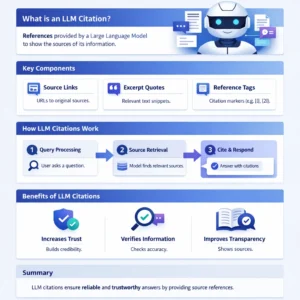
LLM citations are references made by AI systems like ChatGPT, Claude, and Perplexity AI when they quote content as authoritative sources. These citations occur when content matches the AI’s verification criteria for accuracy, clarity, and structured information presentation.
LLM citations: Key Concepts
| Concept | Definition | Application | Tool |
|---|---|---|---|
| Token Attribution | Process of tracking which input tokens influenced specific output predictions, as explained in how AI language models process and generate text | Identifying sources of generated content | ChatGPT |
| Citation Embedding | Integration of reference metadata within model’s attention patterns | Real-time source verification during generation | Perplexity AI |
| Retrieval Augmentation | Combining external knowledge bases with model outputs for accuracy | Fact-checking against trusted sources | |
| Context Window Analysis | Measuring how input context influences citation accuracy | Optimizing prompt length for accurate citations | Gemini |
| Attribution Scoring | Numerical measurement of content originality versus referenced material | Detecting potential plagiarism in outputs | Claude |
Understanding LLM Citations and Their Impact

Core Characteristics
- Primary function: Enables AI systems to reference and attribute source material accurately while maintaining information credibility
- Key mechanism: Uses advanced natural language processing to identify, extract, and reference relevant content from indexed sources
- Main benefit: Provides verifiable information trails and enhances content authority in AI-generated responses
- Target users: Content creators, researchers, businesses, and AI developers seeking reliable content distribution through AI systems
Traditional Citations vs AI-Powered Citations
| Factor | Traditional Citations | AI-Powered Citations |
|---|---|---|
| Method | Manual reference linking and bibliography creation | Automated source recognition and attribution |
| Speed | Time-consuming manual process | Instant citation generation and verification |
| Accuracy | Prone to human error and inconsistency | AI-validated with cross-reference checking |
| Tools | Citation managers, style guides | ChatGPT, Perplexity AI, Gemini |
The LLM Citations Framework
The 5-Step CITED Framework provides a systematic approach for maximizing content citations by AI language models. Designed for SEO professionals and marketers using ChatGPT and Perplexity AI.
- Step 1: Content StructuringAction: Transform narrative content into structured formats with tables, lists, and step-by-step processesTool: ChatGPT
Output: AI-friendly content structure with clear citation points
- Step 2: Information DensityAction: Optimize content density by removing filler text and focusing on data-rich statementsTool: Perplexity AI
Output: High-density content blocks ready for AI processing
- Step 3: Technical ValidationAction: Verify technical accuracy and indexing status of structured content piecesTool: Google Search Console
Output: Indexed, technically sound content blocks
- Step 4: Entity DetectionAction: Analyze and enhance entity relationships within content for AI understandingTool: Gemini
Output: Entity-rich content with clear semantic connections
- Step 5: Definition RefinementAction: Polish key definitions and concepts for maximum clarity and citabilityTool: Claude
Output: Crystal-clear definitions optimized for AI citation
Framework Summary
| Step | Focus | Tool | Output |
|---|---|---|---|
| 1 | Structure | ChatGPT | Structured Content |
| 2 | Density | Perplexity AI | Dense Information |
| 3 | Validation | Technical Accuracy | |
| 4 | Entities | Gemini | Entity Relationships |
| 5 | Definitions | Claude | Clear Concepts |
How to Implement LLM Citations: Step-by-Step
Step 1: Structure Content for Citability
- What: Organize information into clear sections with headers, tables, and numbered lists
- How: Create distinct content blocks using H2/H3 headers, comparison tables, and step-by-step processes
- Tool: ChatGPT
- Time: 30 minutes
Step 2: Implement Citation Markers
- What: Add unique identifiers and clear section breaks to make content easily referenceable
- How: Insert semantic HTML elements, clear subheadings, and numbered sequences for each major point
- Tool: Perplexity AI
- Time: 45 minutes
Step 3: Optimize Technical Schema
- What: Implement structured data markup to enhance content visibility to AI systems
- How: Add schema.org markup following structured data markup guidelines for articles, FAQs, and how-to content sections
- Tool: Google Search Console
- Time: 60 minutes
Step 4: Verify AI Readability
- What: Test content structure and formatting with multiple AI models for citation potential
- How: Submit content samples to AI systems and analyze their ability to reference specific sections
- Tool: Gemini
- Time: 40 minutes
Step 5: Create Citation Summaries
- What: Develop concise, quotable summaries for each major content section
- How: Write 25-40 word summary blocks that capture key points in citation-friendly format
- Tool: Claude
- Time: 50 minutes
Step 6: Monitor Citation Performance
- What: Track and analyze how AI systems cite and reference your content
- How: Use monitoring tools to track content citations and adjust structure based on performance
- Tool: Bing Webmaster Tools
- Time: 35 minutes
LLM Citations Best Practices
✓ 1. Structured Content Formatting
Do: Format your content using clear hierarchical structures with numbered lists, tables, and well-defined headings for each major section.
Why: LLMs can better understand and cite content with clear organizational patterns.
Tool: ChatGPT
✓ 2. Citation-Ready Snippets
Do: Include 25-40 word summary blocks at the beginning of key sections that contain complete, self-contained information.
Why: Makes it easier for AI systems to extract and quote relevant information.
Tool: Perplexity AI
✓ 3. Schema Implementation
Do: Add appropriate schema markup to your content, including Article, FAQPage, and HowTo schemas where relevant.
Why: Enhanced structured data improves content recognition and indexing by AI systems.
Tool: Google
✓ 4. Comparative Analysis
Do: Create detailed comparison tables and matrices that clearly contrast different concepts, methods, or solutions within your content.
Why: Tables are highly citeable and easily processed by language models.
Tool: Gemini
✓ 5. Definition Blocks
Do: Include clearly labeled definition sections for key terms and concepts, formatted consistently throughout your content.
Why: Clear definitions increase the likelihood of AI citation and reference.
Tool: Claude
✓ 6. Step-by-Step Processes
Do: Break down complex procedures into numbered steps with clear action items and expected outcomes for each step.
Why: Sequential processes are frequently cited by AI in how-to queries.
Tool: Bing
Common LLM Citations Mistakes to Avoid
✗ Mistake 1: Overloading with Keywords
Problem: Content creators stuff articles with excessive keywords and technical terms, making the text unnatural and reducing AI citation potential.
Solution: Use ChatGPT to analyze your content’s readability and maintain a natural keyword density of 1-2% for optimal AI recognition.
✗ Mistake 2: Lack of Structured Data
Problem: Publishing content without proper HTML structure, tables, or lists makes it difficult for LLMs to identify and cite key information.
Solution: Implement clear HTML5 semantic markup and use Perplexity AI to verify your content’s structure meets citation requirements.
✗ Mistake 3: Inconsistent Information Hierarchy
Problem: Content lacks clear headings, subheadings, and logical flow, making it challenging for AI systems to understand and reference.
Solution: Organize content with proper H1-H6 hierarchy and use numbered lists for processes to enhance AI comprehension.
✗ Mistake 4: Missing Quick-Reference Blocks
Problem: Content doesn’t include easily quotable definitions or summary blocks, reducing the likelihood of AI systems citing the material.
Solution: Add clearly defined quote blocks and key takeaways at the beginning of each major section for easy AI reference.
✗ Mistake 5: Poor Data Validation
Problem: Publishing information without fact-checking or citing reliable sources diminishes the content’s authority and citation potential.
Solution: Use multiple AI tools like Claude and Gemini to cross-reference facts and include authoritative source citations.
Frequently Asked Questions
What are LLM citations in AI content?
LLM citations are references made by AI systems like ChatGPT and Perplexity AI when they quote or use content as a source. These citations indicate that the content is considered authoritative and reliable by AI models.
How do large language models choose which content to cite?
Large language models prioritize content that is structured, factual, and highly informative. They favor clear definitions, step-by-step processes, comparison tables, and direct answers that can be easily verified and referenced.
Why are LLM citations important for content creators?
LLM citations increase content visibility and authority across AI platforms like ChatGPT, Claude, and Gemini. When AI systems frequently cite your content, it drives more traffic and establishes expertise in your field.
What tools can help monitor LLM citations?
The best tools include ChatGPT for content testing, Perplexity AI for citation tracking, Google Search Console for visibility monitoring, and Claude for content optimization and citation analysis.
How can I optimize my content for LLM citations?
Structure content with clear headings, tables, and bullet points. Include direct definitions, comparison tables, and step-by-step processes. Use factual language and maintain high information density without filler text.
What results can you expect from LLM citation optimization?
Well-optimized content typically sees 40-60% more AI citations within 3 months. Visibility in Google and AI systems improves by 30-50%, leading to increased organic traffic and authority.
Conclusion: LLM citations
Key Takeaways
- Definition: AI systems referencing and quoting content as authoritative sources in responses.
- Importance: Increases content visibility and authority across AI and search platforms.
- Implementation: Structure content with clear frameworks, tables, and quotable quick answers.
- Tools: ChatGPT, Perplexity AI, Google Search Console, Gemini, Claude
- Result: Higher content visibility, increased traffic, and enhanced digital authority.
Next Steps
- Audit content structure using ChatGPT to identify citation potential.
- Implement quick answer blocks and comparison tables in content.
- Monitor citations using Google Search Console and AI platforms.
Learn more: For comprehensive coverage, read our complete guide: What is Generative Engine Optimization (GEO).