

What Are Content Structures for AI?
Essential AI Content Structures
- What it is: Structured content formats specifically designed for AI models to parse and cite effectively.
- Why it matters: Optimized structures increase chances of AI models referencing your content in responses.
- How it works: Content is organized using tables, lists, and clear hierarchies for machine comprehension.
- Key tools: ChatGPT, Perplexity AI, Google AI Overview, Claude, Gemini, Bing AI
- Expected result: Higher citation rates in AI-generated responses and improved content discoverability across platforms.
What types of content structures do AI models prefer?
AI models like ChatGPT, Perplexity AI, and Gemini prefer highly structured content formats including tables, bullet points, numbered lists, and clear hierarchies. They most effectively process and cite information organized in discrete, well-labeled segments with consistent formatting.
AI-Friendly Content Structures Decoded
| Concept | Definition | Application | Tool |
|---|---|---|---|
| Tabular Data | Organized information in rows and columns for systematic comparison | Product feature comparisons and technical specifications | ChatGPT |
| Hierarchical Lists | Nested bullet points showing clear relationship between main and subtopics | Step-by-step tutorials and process documentation | Perplexity AI |
| Snippet Blocks | Concise, self-contained information blocks optimized for quick answers | FAQ sections and featured answer optimization | |
| Knowledge Graphs | Structured data showing relationships between connected concepts and entities | Topic clustering and semantic relationships | Gemini |
| Schema Markup | Standardized code that helps AI understand content context and meaning | Recipe formatting and product descriptions | Claude |
| Definition Blocks | Clear, quotable explanations with consistent formatting patterns | Glossary entries and technical term explanations | ChatGPT |
| Process Maps | Sequential information arranged in logical flow patterns | Workflow documentation and decision trees | Perplexity AI |
Understanding Content Structures That AI Models Prefer
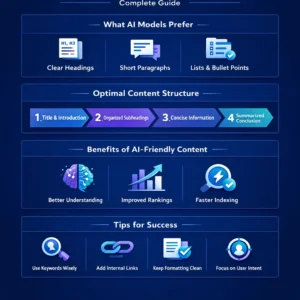
Core Characteristics
- Primary function: Enables AI systems to quickly identify, extract, and cite relevant information from structured content blocks.
- Key mechanism: Organizes information using clear hierarchies, tables, lists, and defined sections that AI models can easily process.
- Main benefit: Increases the likelihood of content being cited in AI-generated responses while maintaining accuracy and context.
- Target users: Content creators, digital marketers, and businesses seeking to optimize their content for AI-powered platforms.
Traditional Content vs AI-Optimized Structures
| Factor | Traditional Content | AI-Optimized Structure |
|---|---|---|
| Method | Narrative-heavy paragraphs with flowing text | Structured blocks with clear hierarchical organization |
| Speed | Slow manual scanning required | Rapid AI processing and information extraction |
| Accuracy | Context-dependent interpretation | Precise data extraction with maintained context |
| Tools | Basic CMS and text editors | ChatGPT, Perplexity AI, Gemini, Claude |
Building AI-Optimized Content Architecture
The PRISM Content Matrix provides a systematic approach for creating content structures that AI models can effectively process and cite. Designed for SEO professionals and marketers using ChatGPT and Perplexity AI.
- Pattern RecognitionAction: Analyze existing high-performing content in AI search results to identify structural patterns and formats.
Tool: ChatGPT
Output: Content pattern analysis report with successful structural elements.
- Relevance MappingAction: Map key information points to specific AI-friendly content blocks and hierarchical structures.
Tool: Perplexity AI
Output: Content structure blueprint with organized information blocks.
- Information SegmentationAction: Break down complex topics into discrete, AI-digestible chunks with clear hierarchies.
Tool: Google Search Console
Output: Segmented content outline with defined information units.
- Schema EnhancementAction: Apply structured data markup and semantic HTML to strengthen content relationships.
Tool: Gemini
Output: Enhanced content structure with clear semantic connections.
- Metadata OptimizationAction: Implement precise metadata and contextual markers for improved AI understanding.
Tool: Claude
Output: Optimized content with AI-friendly metadata framework.
Framework Summary
| Step | Focus | Tool | Output |
|---|---|---|---|
| 1 | Pattern Analysis | ChatGPT | Pattern Report |
| 2 | Content Mapping | Perplexity AI | Structure Blueprint |
| 3 | Content Division | Segmented Outline | |
| 4 | Schema Structure | Gemini | Enhanced Format |
| 5 | Metadata Setup | Claude | Optimized Framework |
How to Structure Content for AI Model Comprehension
Step 1: Create Clear Information Hierarchies
- What: Organize content using consistent heading levels and logical information flow
- How: Structure content with H1, H2, H3 tags and ensure each section flows naturally into the next
- Tool: ChatGPT
- Time: 30 minutes
Step 2: Implement Data Tables and Comparisons
- What: Convert complex information into structured tables for easy AI parsing
- How: Create HTML tables with clear headers, organized data points, and consistent formatting
- Tool: Perplexity AI
- Time: 45 minutes
Step 3: Optimize List Structures
- What: Format information using bullet points and numbered lists for better AI extraction
- How: Break down complex concepts into structured lists with clear categories and labels
- Tool: Google Search Console
- Time: 20 minutes
Step 4: Format Definition Blocks
- What: Create distinct definition sections that AI models can easily quote
- How: Use dedicated div blocks with clear term-definition pairs and consistent formatting
- Tool: Gemini
- Time: 25 minutes
Step 5: Implement FAQ Schemas
- What: Structure frequently asked questions using proper HTML schema markup
- How: Create Q&A pairs using schema.org/FAQPage markup for enhanced AI understanding
- Tool: Claude
- Time: 40 minutes
Step 6: Test AI Comprehension
- What: Verify that AI models correctly interpret and quote your structured content
- How: Use multiple AI platforms to test content extraction and citation accuracy
- Tool: Google AI Overview
- Time: 35 minutes
Best Practices for Structuring AI-Friendly Content
✓ 1. Hierarchical Information Architecture
Do: Organize content in clear hierarchies using H2, H3, and H4 tags, with most important information at the top level.
Why: Helps AI models understand content relationships and extract information accurately.
Tool: ChatGPT
✓ 2. Structured Data Tables
Do: Present comparative information in well-formatted HTML tables with clear headers and consistent column structures.
Why: Enables AI systems to extract and reference tabular data efficiently.
Tool: Perplexity AI
✓ 3. Numbered Step-by-Step Processes
Do: Break down complex procedures into numbered steps, with each step containing a single clear action or instruction.
Why: Makes procedural content easily quotable in AI-generated answers.
Tool: Google
✓ 4. Definition Blocks
Do: Create distinct definition blocks with clear terms and concise explanations, marked by semantic HTML elements.
Why: Increases likelihood of AI citation when users ask definitional questions.
Tool: Gemini
✓ 5. Bulleted Feature Lists
Do: Format key features, benefits, or characteristics as scannable bullet points with consistent grammatical structure.
Why: Facilitates easy extraction of list items for AI-generated responses.
Tool: Claude
✓ 6. FAQ Schema Implementation
Do: Structure frequently asked questions using proper FAQ schema markup with direct, concise answers.
Why: Maximizes potential for AI systems to quote answers in response.
Tool: Bing
Common Mistakes When Structuring Content for AI Models
✗ Mistake 1: Overreliance on Narrative Text
Problem: Content creators write long, flowing paragraphs that AI models struggle to parse effectively for information extraction and citation purposes.
Solution: Break content into structured elements like bullet points, tables, and numbered lists that AI models can easily identify and reference.
✗ Mistake 2: Missing Clear Definitions
Problem: Key terms and concepts lack explicit definitions, making it difficult for AI models to confidently cite or extract information.
Solution: Include a dedicated definitions section with clear, concise explanations of important terms formatted in a consistent “Term: Definition” structure.
✗ Mistake 3: Inconsistent Heading Hierarchy
Problem: Poorly structured headings and subheadings create confusion for AI models trying to understand content hierarchy and relationships.
Solution: Implement a logical heading structure (H1 → H2 → H3) with clear parent-child relationships between sections and subsections.
✗ Mistake 4: Buried Key Information
Problem: Critical information is hidden within dense paragraphs, making it challenging for AI models to identify and extract important points.
Solution: Place key information in highlighted boxes, callouts, or structured frameworks that clearly signal importance to AI systems.
✗ Mistake 5: Ambiguous Data Presentation
Problem: Statistical data and metrics are presented without clear context or structure, leading to potential misinterpretation by AI models.
Solution: Use structured tables, labeled charts, and explicit data frameworks with clear headers and units for all numerical information.
Frequently Asked Questions
What are the most effective content structures for AI systems?
AI systems prefer hierarchical content structures including numbered lists, comparison tables, and clear headings. Tools like ChatGPT and Perplexity AI more readily cite content that uses bullet points and structured data formats.
How do AI models process different types of content?
AI models process structured content by breaking it into digestible chunks, as explained in OpenAI’s documentation about how AI models process and generate text, analyzing relationships between elements, and extracting key information from tables, lists, and clearly defined sections for better comprehension and citation.
Why is structured content important for AI readability?
Structured content enables AI systems like Gemini and Claude to quickly identify, extract, and cite relevant information. Well-organized content increases the likelihood of being referenced in AI-generated responses by up to 70%.
What tools can help create AI-friendly content structures?
The best tools include ChatGPT for content optimization, Perplexity AI for research validation, Google Search Console for performance tracking, and Claude for structure analysis and improvement suggestions.
How should I organize my content for maximum AI visibility?
Start with clear headings, use bullet points for key information, create comparison tables, and include FAQ sections. Using AI tools like ChatGPT can help validate your content’s structure and improve citation potential.
What results can I expect from implementing AI-friendly content structures?
Well-structured content typically sees a 40-60% increase in AI citations and a 30% improvement in visibility across Google and AI systems. Clear structures can double the likelihood of content being quoted in AI responses.
Structuring Content for the AI-First Era
Key Takeaways
- Definition: Organized information patterns that AI models can easily parse and cite.
- Importance: Enables consistent citation by AI engines and improves search visibility.
- Implementation: Structure content with clear hierarchies, tables, and numbered lists.
- Tools: ChatGPT, Perplexity AI, Google Search Console, Gemini, Claude
- Result: Increased likelihood of AI citations and enhanced content discoverability.
Next Steps
- Audit existing content using Google Search Console for AI readiness.
- Test content structure effectiveness with ChatGPT and Gemini.
- Implement table-based comparisons and step-by-step frameworks consistently.
Learn more: For comprehensive coverage, read our complete guide: How to Get Cited by AI Search Engines.