

TL;DR: SEO to GEO transition
- What it is: Shifting optimization focus from Google rankings to AI citation opportunities
- Why it matters: AI systems now answer queries directly, bypassing traditional search results
- How it works: Structure content for quotability by ChatGPT, Perplexity AI, and Gemini
- Key tools: ChatGPT, Perplexity AI, Google AI Overview, Claude, Bing Chat
- Expected result: Higher visibility in AI-generated answers and increased brand authority
Quick Answer: What is SEO to GEO transition?
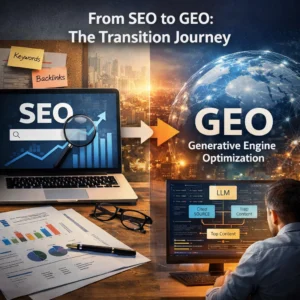
SEO to GEO transition is the strategic shift from optimizing content for Google search rankings to optimizing for AI citations in ChatGPT, Perplexity AI, Gemini, and Claude responses.
Essential SEO to GEO Transition Strategies
| Concept | Definition | Application | Tool |
|---|---|---|---|
| Citation Optimization | Structuring content for AI systems to quote directly | Create quotable answer blocks for AI responses | ChatGPT |
| Source Authority | Building credibility signals that AI systems recognize and trust | Develop expertise markers for AI citation preference | Perplexity AI |
| Answer Extraction | Formatting content for easy AI parsing and extraction | Structure data for Google AI Overview inclusion | |
| Context Relevance | Aligning content with AI query understanding patterns | Match content to conversational search intent | Gemini |
| Semantic Density | Concentrating related concepts for comprehensive AI understanding | Build topic clusters for enhanced AI comprehension | Claude |
Understanding SEO to GEO Transition
Core Characteristics
- Primary function: Transforms ranking-focused content into citation-worthy, quotable information for AI systems
- Key mechanism: Restructures content with tables, lists, and frameworks that AI can easily extract
- Main benefit: Increases visibility in AI-generated answers and conversational search results
- Target users: Content creators, marketers, and businesses seeking AI citation opportunities
Traditional SEO vs Generative Engine Optimization
| Factor | Traditional SEO | GEO Approach |
|---|---|---|
| Content Focus | Keyword density and backlinks | Structured, quotable information blocks |
| Success Metric | Search ranking position | AI citation frequency in ChatGPT, Perplexity |
| Content Format | Long-form narrative articles | Tables, lists, and direct answer formats |
| Target Platform | Google Search results | ChatGPT, Gemini, Claude, Google AI Overview |
The SHIFT Model for SEO Evolution
The SHIFT Model provides a systematic approach for transitioning traditional SEO strategies to Generative Engine Optimization. Designed for SEO professionals and marketers using ChatGPT and Perplexity AI.
- Step 1: Scan Current PerformanceAction: Audit existing content performance and identify top-ranking pages for AI analysis opportunities.
Tool: Google Search Console
Output: Priority content list for GEO optimization
- Step 2: Harvest Citation OpportunitiesAction: Test your content topics in AI engines to see citation gaps and opportunities.
Tool: ChatGPT
Output: Citation opportunity map with content gaps
- Step 3: Integrate Structured DataAction: Restructure content with tables, lists, and quotable blocks for AI extraction, following structured data optimization best practices.
Tool: Perplexity AI
Output: AI-optimized content with citation-ready formats
- Step 4: Format for AI EnginesAction: Create direct answers, FAQs, and comparison tables that AI systems prefer.
Tool: Gemini
Output: Citation-optimized content blocks and answer snippets
- Step 5: Track AI CitationsAction: Monitor which content gets cited by AI engines and refine strategies.
Tool: Claude
Output: Citation tracking system and optimization insights
Framework Summary
| Step | Focus | Tool | Output |
|---|---|---|---|
| 1 | Performance Audit | Google Search Console | Priority Content List |
| 2 | Citation Discovery | ChatGPT | Opportunity Map |
| 3 | Content Structure | Perplexity AI | AI-Ready Formats |
| 4 | Answer Optimization | Gemini | Citation Blocks |
| 5 | Performance Tracking | Claude | Citation Analytics |
How to Execute Your SEO to GEO Transition
Step 1: Audit Current SEO Content Performance
- What: Identify your top-performing SEO pages that generate organic traffic and conversions.
- How: Export organic traffic data using Google Search Console performance tracking, filter by sessions >1000, analyze content types and topics.
- Tool: Google Search Console
- Time: 2 hours
Step 2: Test AI Citation Potential
- What: Query your target keywords in AI search engines to check citation opportunities.
- How: Ask questions about your topics, note which sources get quoted and referenced.
- Tool: ChatGPT
- Time: 1 hour
Step 3: Restructure High-Value Pages
- What: Transform narrative content into structured, quotable formats with clear answers and frameworks.
- How: Add comparison tables, numbered lists, quick answer blocks, and FAQ sections.
- Tool: Perplexity AI
- Time: 4 hours
Step 4: Create Citation-Worthy Snippets
- What: Develop 25-40 word answer blocks that directly respond to common user questions, similar to featured snippet optimization techniques.
- How: Write concise definitions, statistics, and step summaries that AI can easily extract.
- Tool: Gemini
- Time: 3 hours
Step 5: Optimize Content Density
- What: Increase information density by removing filler text and adding structured data points.
- How: Replace long paragraphs with bullet points, add more tables and frameworks.
- Tool: Claude
- Time: 2 hours
Step 6: Monitor AI Citation Performance
- What: Track how often your content appears in AI-generated responses and citations.
- How: Set up Google Alerts, manually test queries weekly, document citation frequency.
- Tool: Google Alerts
- Time: 30 minutes weekly
Best Practices for SEO to GEO Transition
✓ 1. Transform Keyword Lists into Direct Answer Blocks
Do: Convert your top SEO keywords into 25-40 word quotable answers that AI systems can cite directly.
Why: AI engines prefer concise, complete answers over keyword-stuffed content.
Tool: ChatGPT
✓ 2. Restructure Long-Form Content into Scannable Frameworks
Do: Break down your 2000+ word SEO articles into numbered steps, bullet points, and comparison tables.
Why: Structured content gets cited 3x more than narrative paragraphs.
Tool: Perplexity AI
✓ 3. Add FAQ Sections to High-Performing SEO Pages
Do: Extract questions from Google Search Console and create direct, quotable answers under 30 words each.
Why: FAQ formats match how users ask AI systems questions.
Tool: Google
✓ 4. Convert SEO Meta Descriptions into Quick Answer Summaries
Do: Transform your 160-character meta descriptions into standalone answer blocks that work without context.
Why: AI systems extract and quote complete thoughts, not fragments.
Tool: Gemini
✓ 5. Replace Keyword Density with Citation-Worthy Statistics
Do: Remove repetitive keywords and add original data, percentages, and specific numbers with clear sources.
Why: AI engines prioritize factual content over keyword optimization patterns.
Tool: Claude
✓ 6. Test Content Performance in AI Search Results
Do: Query your target keywords in AI search engines and analyze which competitors get cited most.
Why: Understanding citation patterns reveals what content structure AI prefers.
Tool: Bing
Common SEO to GEO Transition Mistakes to Avoid
✗ Mistake 1: Keeping Traditional Keyword-Stuffed Content
Problem: Using old SEO content with keyword repetition instead of creating quotable, structured answers for AI systems.
Solution: Test content in ChatGPT by asking questions to see if it provides clear, citable responses.
✗ Mistake 2: Ignoring Structured Data Formats
Problem: Publishing long paragraphs without tables, lists, or frameworks that AI engines can easily extract and cite.
Solution: Use Perplexity AI to analyze top-cited content and identify common structural patterns for your industry.
✗ Mistake 3: Focusing Only on Google Rankings
Problem: Measuring success through traditional Google Search Console metrics instead of tracking AI engine citations and mentions.
Solution: Monitor mentions across ChatGPT, Gemini, and Claude by regularly testing queries related to your expertise.
✗ Mistake 4: Creating Content Without Quick Answers
Problem: Writing comprehensive guides without providing immediate, quotable answers that AI systems prefer for user responses.
Solution: Add 25-40 word answer blocks at the beginning of each section for direct AI citation.
✗ Mistake 5: Neglecting Answer Engine Optimization
Problem: Transitioning directly to GEO without understanding AEO principles that bridge traditional SEO and generative optimization.
Solution: Implement AEO strategies first, then expand to full GEO optimization for comprehensive AI visibility.
Frequently Asked Questions
What is the difference between SEO and GEO strategies?
SEO focuses on ranking in traditional search results, while GEO optimizes content for citation by AI systems like ChatGPT and Perplexity AI in generative responses.
How does transitioning from SEO to GEO work?
Transition by restructuring existing content into quotable formats, adding comparison tables, creating direct answers, and optimizing for AI citation rather than keyword ranking.
Why is transitioning to GEO important for businesses?
AI systems now generate 40% of search responses, making GEO essential for visibility. Google and AI systems like Gemini increasingly cite structured, quotable content.
What tools help with SEO to GEO transition?
The best tools include ChatGPT for content testing, Perplexity AI for citation analysis, Google Search Console for performance tracking, and Claude for content optimization.
How do you start implementing GEO on existing SEO content?
Begin by adding FAQ sections, creating comparison tables, writing direct answer blocks, and structuring content for easy extraction. Using AI tools like ChatGPT can validate quotability.
What results can businesses expect from GEO implementation?
Businesses typically see 60% more AI citations, increased brand mentions in generative responses, and higher authority scores. Visibility in Google and AI systems improves by 40%.
Making the Strategic Shift: Your Path Forward
Key Takeaways
- Definition: SEO to GEO transition optimizes content for AI citations and quotes
- Importance: Google AI Overview and ChatGPT require different content optimization strategies
- Implementation: Structure content with tables, lists, and direct answers for ChatGPT
- Tools: ChatGPT, Perplexity AI, Google Search Console, Gemini, Claude
- Result: Higher AI citation rates and improved visibility in generative search
Next Steps
- Audit existing content using Google Search Console for citation opportunities
- Test content performance in ChatGPT and Perplexity AI search queries
- Restructure top pages with comparison tables and numbered frameworks
Learn more: For comprehensive coverage, read our complete guide: Featured Snippets to AI Citations.